
Select a trading day to view all Scanner results, chart evidence, and market explanations.
5 Scanners Available
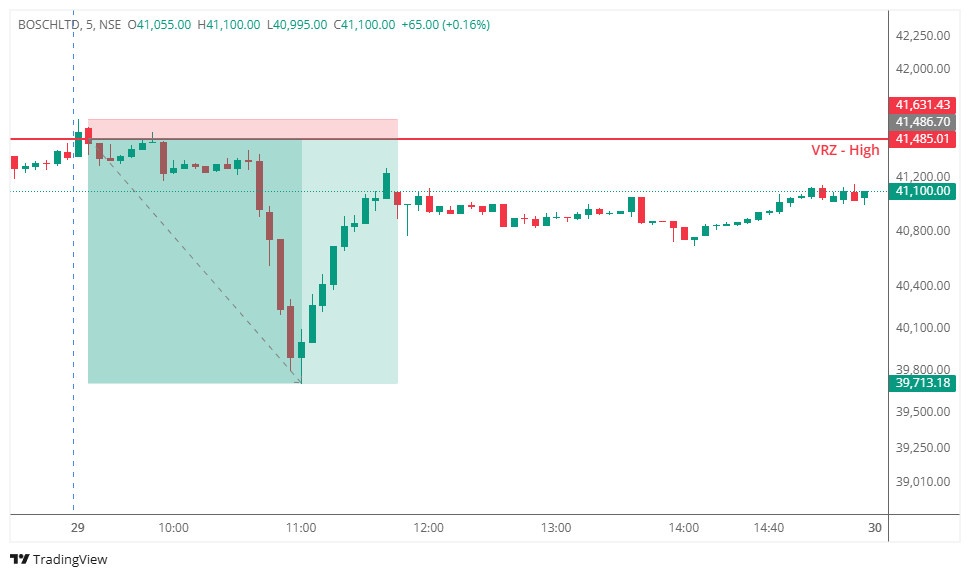

🔹 BOSCHLTD tested the VRZ High, with buyers attempting to sustain price above the key resistance.
⚠️ The breakout failed to hold, and price reversed back below the VRZ High, confirming the Breakout Failure (BOF) setup. 🔻
📊 Bullish momentum weakened as sellers stepped in and gained control.
🔴 Price moved sharply lower from the VRZ High, delivering a 4.27% move with an impressive 1:12 Risk-Reward. 🎯
⚔️ Buyer vs Seller Activity
🟢 Buyers: Attempted to sustain the breakout above the VRZ High.
🟡 Breakout Traders: Were trapped when price reversed below the key level.
🔴 Sellers: Took control and drove the bearish reversal.
🎭 The failed breakout weakened buyer confidence and triggered selling pressure.
📉 Trapped buyers exiting their positions further supported the bearish move.
1️⃣ Wait for Confirmation: A confirmed rejection helps validate the BOF setup.
2️⃣ Watch Trapped Traders: Failed breakouts can accelerate reversals as trapped participants exit.
3️⃣ Manage Risk: A clear invalidation level helps maintain disciplined execution.
🔹 The setup became actionable after price failed to sustain above the VRZ High and moved back below the zone.
📉 Sellers drove a strong downside move before buyers later attempted a recovery.
🏅 The trade delivered a 4.27% move with a remarkable 1:12 RR.
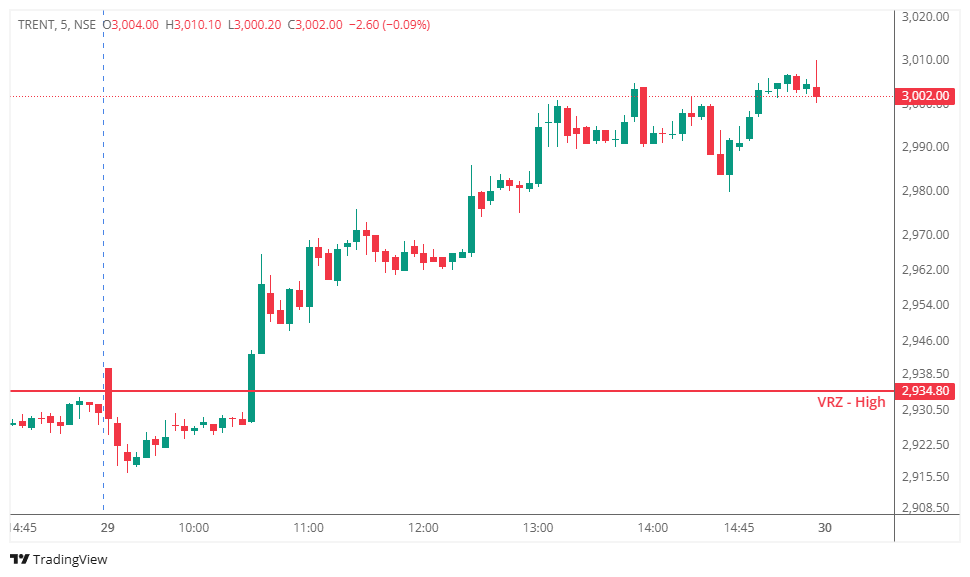

TRENT opened with increased volatility before approaching the VRZ High, a key resistance level where sellers were expected to defend the breakout.
As price briefly crossed above the VRZ High and then moved back below the level, the chart presented a potential Breakout Failure (BOF) short opportunity. The initial rejection suggested weakening buying momentum, making it a valid setup according to the Logical Trading System (LTS).
Following the breakout above ₹2,934.80, price showed an early rejection, triggering the BOF sell setup.
However, the rejection lacked strong bearish follow-through.
Instead of extending lower, buyers quickly absorbed the selling pressure and reclaimed the breakout zone. The VRZ High transformed from resistance into support, signaling that bullish momentum remained intact.
As the session progressed, TRENT continued forming higher highs and higher lows, confirming sustained buying strength. The continued bullish momentum eventually triggered the predefined stop loss, invalidating the BOF short trade.
This price action clearly showed that institutional buying outweighed the initial selling pressure, resulting in a strong trend continuation.
The BOF setup lost its probability because sellers failed to maintain control after entry.
Key warning signs included:
❌ Price quickly reclaimed the VRZ High.
❌ Selling momentum faded immediately after the rejection.
❌ Buyers continued forming higher lows.
❌ Bullish candles dominated the intraday structure.
❌ The breakout zone converted into strong support.
These signals confirmed that buyers had regained control, significantly reducing the probability of a successful BOF reversal.
The chart showcases a classic BOF failure, where the anticipated reversal lost momentum and the prevailing bullish trend resumed with strength.
🔹 Buyers successfully pushed price above the resistance zone.
🔸 Sellers attempted to reject the breakout and initiate a reversal.
🔺 Bearish follow-through remained weak, failing to confirm the setup.
🔷 Buyers quickly regained control and reclaimed the VRZ High.
⭐ Fresh buying momentum drove the stock to new intraday highs.
💠 The breakout remained valid as bullish market structure continued to strengthen.
This type of price action often reflects institutional accumulation, where early short sellers become trapped before the market extends in the direction of the dominant trend.
⚠️ Every BOF setup has a probability of failure—no strategy wins every trade.
📉 A stop loss does not indicate poor execution; it simply reflects changing market dynamics.
🏦 Strong institutional buying can invalidate even the highest-probability reversal setups.
🛡️ Following predefined rules and respecting stop losses is what separates professional traders from emotional traders.
🎯 Long-term profitability comes from consistent execution—not from being right on every trade.
A BOF Short becomes vulnerable when:
❌ Price immediately reclaims the breakout level.
❌ Buyers continue creating higher lows.
❌ Selling pressure fails to expand.
❌ Bullish momentum strengthens after entry.
❌ The VRZ High shifts from resistance to support.
This trade met all the rules of the Logical Trading System (LTS) and therefore remained a valid execution despite the financial loss.
Professional traders understand that:
✅ A good trade can still result in a loss.
✅ Risk management is more important than prediction.
✅ Discipline creates consistency over hundreds of trades.
✅ Every controlled loss protects capital for future opportunities.
Trading is a probability-based business where following the process always takes priority over individual outcomes.
Professional traders focus on preserving capital rather than avoiding losses.
In this trade:
✅ Entry followed the predefined trading plan.
✅ Risk was calculated before execution.
✅ Stop loss was respected without hesitation.
✅ No emotional averaging or revenge trading occurred.
✅ Trading discipline remained intact.
Small, controlled losses are an investment in long-term trading consistency.
🌍 Markets constantly test a trader's patience, discipline, and emotional control.
⚠️ This TRENT BOF Failure demonstrates that a failed reversal often confirms the strength of the prevailing trend.
🛡️ Successful traders don't eliminate losses—they control them through disciplined execution and proper risk management.
📈 Long-term success comes from allowing disciplined winners to outperform small, planned losses over a large sample of trades.
💪 Trust your trading system, respect your stop loss, and stay committed to consistency over perfection.
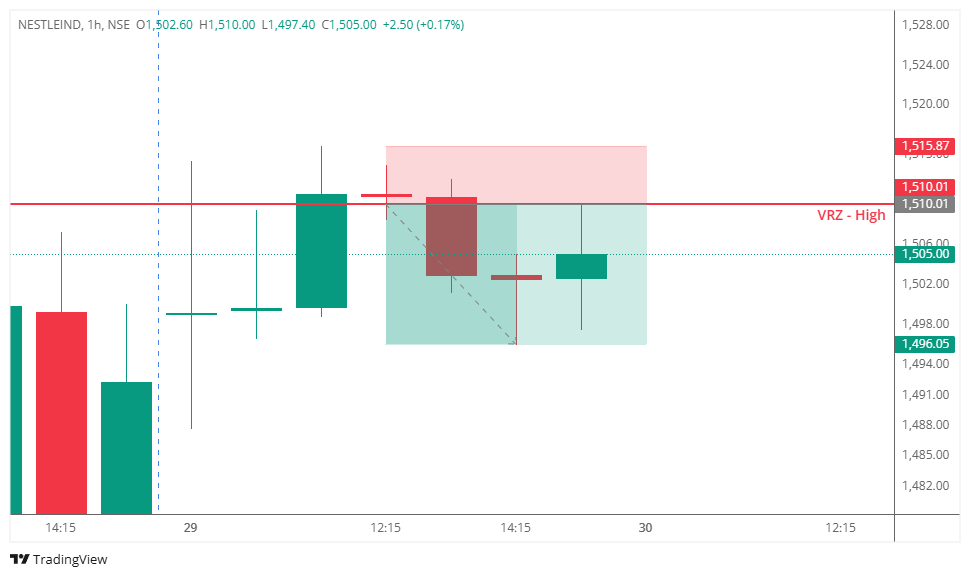

🎯 Nestlé India approached the previously identified VRZ High at ₹1,510.01 and briefly traded above the resistance zone, creating the impression that a bullish breakout was underway.
📈 The initial move attracted breakout buyers who expected the stock to continue higher after challenging the key resistance level.
⚠️ However, the breakout failed to sustain.
🔻 Selling pressure emerged near the VRZ High and pushed price back below ₹1,510.01. The following hourly candles confirmed rejection from the resistance zone, signaling that buyers were unable to maintain control.
✅ This price action confirmed a classic Breakout Failure (BOF) setup.
📉 As the failed breakout became evident, trapped buyers began exiting their positions while fresh sellers entered the market. This combination of long unwinding and new selling pressure triggered a 0.92% downside move, successfully achieving the planned 1:2 risk-reward target.
Many traders believed:
🚀 The breakout above resistance would continue.
📈 Buyers had gained control of the short-term trend.
🔝 Higher prices were likely after the resistance breakout.
The market reacted differently.
🔻 Price failed to sustain above ₹1,510.01.
⚠️ Breakout buyers became trapped.
🐻 Sellers regained control near the VRZ High.
📉 Bearish momentum strengthened as long positions were unwound.
This shift from bullish optimism to bearish control fueled the successful downside move.
🔹 A Breakout Needs Sustained Acceptance
A temporary move above the VRZ High does not confirm a genuine breakout. Price must sustain above resistance to validate the move.
🔹 Rejection Signals Weak Buyer Conviction
The quick rejection near ₹1,510.01 highlighted selling pressure and the inability of buyers to defend higher prices.
🔹 Failed Breakouts Can Create Short Opportunities
When breakout buyers become trapped, their exits can combine with fresh selling to accelerate bearish momentum.
🔹 Confirmation Improves Trade Quality
Waiting for price to confirm rejection below the VRZ High provided a structured BOF short setup with clearly defined risk.
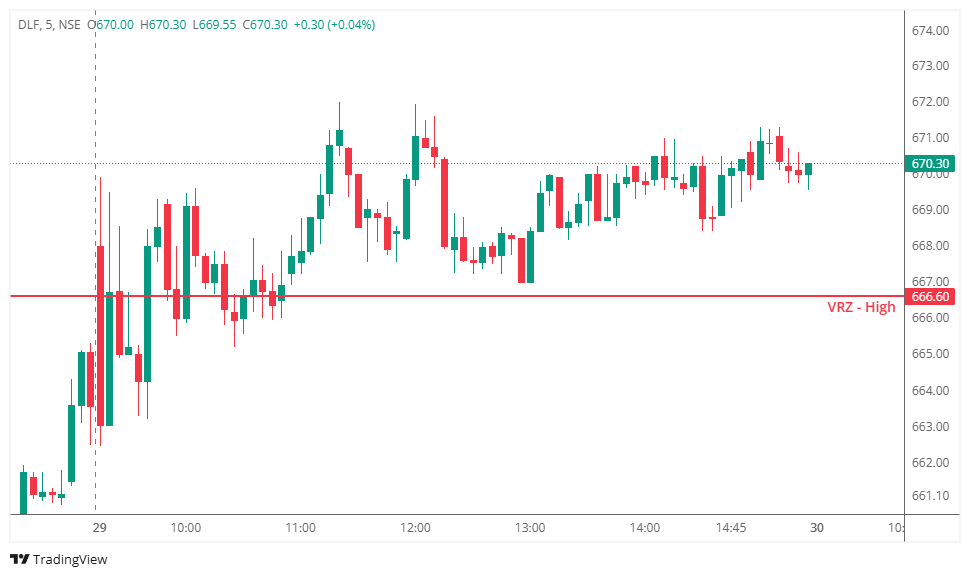

DLF approached the VRZ High after a strong intraday recovery, bringing price into a key resistance zone where sellers were expected to defend aggressively.
As price briefly moved above the VRZ High and then slipped back below the level, the setup met the criteria for a Breakout Failure (BOF) short trade. The rejection initially suggested that buyers were losing momentum, offering a potential selling opportunity.
The BOF sell setup triggered after price showed early rejection around the ₹666.60 VRZ High.
However, the bearish follow-through never developed.
Instead of continuing lower, buyers absorbed the selling pressure and steadily regained control. Price reclaimed the breakout zone, converting resistance back into support.
As the session progressed, DLF continued to form higher lows and higher highs, confirming sustained buying strength. The failed rejection eventually triggered the predefined stop loss, invalidating the BOF short setup.
This price action clearly demonstrated that institutional buyers remained in control despite the initial rejection signal.
The BOF setup lost its edge because the market failed to confirm bearish momentum after entry.
Key warning signs included:
❌ Price quickly reclaimed the VRZ High.
❌ Selling pressure failed to accelerate.
❌ Buyers continued defending higher prices.
❌ Bullish candles appeared after the rejection.
❌ Market structure shifted from potential reversal to trend continuation.
Once these signals appeared, the probability of the BOF succeeding dropped significantly.
The chart reflects a classic failed BOF followed by bullish continuation.
📌 Buyers pushed price above resistance.
📌 Sellers attempted to reject the breakout.
📌 The rejection lacked strong follow-through.
📌 Buyers reclaimed the VRZ High with confidence.
📌 Price continued making higher highs, confirming trend continuation.
This is a common scenario where weak short positions are trapped before the market resumes its primary bullish trend.
⚠️ Every BOF setup carries a probability of failure—no trading strategy guarantees success on every trade.
📉 A losing trade does not mean the setup was wrong; it simply means market conditions changed after entry.
🏦 Professional traders recognize that strong institutional buying can invalidate even high-probability reversal setups.
🛡️ Following predefined rules and respecting stop losses is what separates disciplined traders from emotional traders.
🎯 Consistency is built through disciplined execution—not by avoiding losses altogether.
A BOF Short becomes vulnerable when:
❌ Price immediately reclaims the breakout zone.
❌ Buyers continue creating higher lows.
❌ Selling momentum weakens after entry.
❌ Bullish candles dominate the price action.
❌ The VRZ level turns into support instead of resistance.
This was a valid BOF trade executed according to the Logical Trading System (LTS).
Although the trade resulted in a controlled loss, the execution remained correct because every trading rule was followed.
Professional traders focus on:
✅ Executing high-quality setups.
✅ Respecting stop losses without hesitation.
✅ Protecting capital through disciplined risk management.
✅ Remaining emotionally neutral regardless of individual trade outcomes.
Trading success is measured over a series of trades—not by a single win or loss.
Successful trading is built on capital preservation rather than prediction.
In this trade:
✅ Entry followed the trading plan.
✅ Risk was predefined before execution.
✅ Stop loss was respected.
✅ No emotional averaging or revenge trading occurred.
✅ Capital remained protected for future opportunities.
Small, controlled losses are an essential cost of maintaining long-term profitability.
🌍 Markets constantly test a trader's patience, discipline, and decision-making.
⚠️ This DLF BOF Failure shows that a failed reversal can often become the strongest confirmation of trend continuation.
🛡️ Professional traders don't aim to eliminate losses—they aim to keep them small, controlled, and consistent through disciplined execution.
📈 Long-term profitability comes from following a proven process where winning trades outweigh controlled losses over time.
💪 Trust your strategy, manage your risk, and let consistency—not emotions—shape your trading journey.
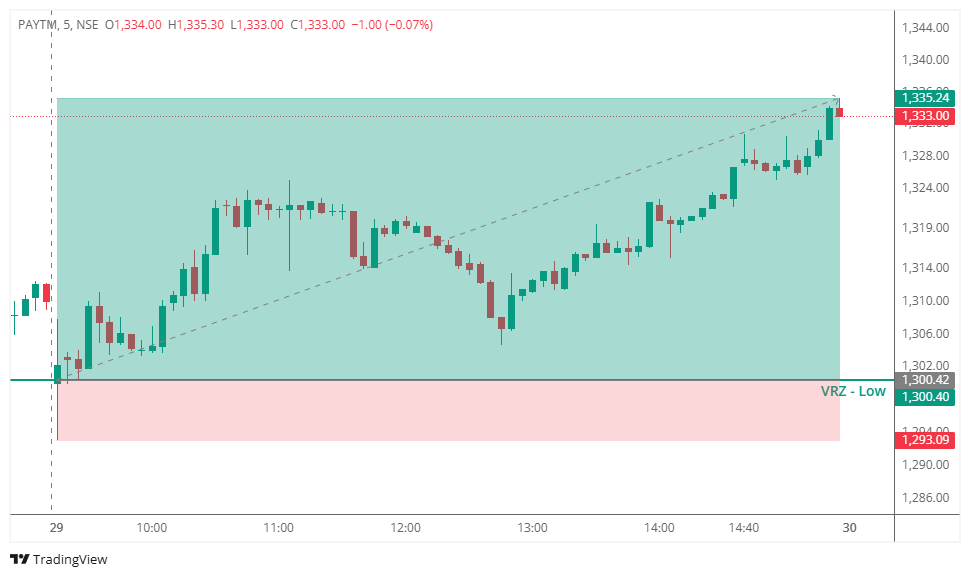

🔹 PAYTM tested the VRZ Low, with sellers attempting to push price below the key support zone.
⚠️ However, the breakdown failed to sustain as price reclaimed the VRZ Low and buyers stepped back into the market.
🔄 This failure of bearish momentum created a potential Breakdown Failure (BOF) setup and signaled a shift in short-term market control.
📈 After the breakdown failure, bullish momentum gradually strengthened.
🟢 Buyers gained control as price moved higher from the VRZ Low and continued forming a bullish intraday structure.
🚀 The confirmed BOF setup eventually delivered a 2.68% bullish move with a 1:4 Risk-Reward.
🔴 Sellers: Initially attempted to break and sustain below the VRZ Low.
🟡 Breakdown Traders: Were trapped when price failed to continue lower and reclaimed the key zone.
🟢 Buyers: Used the failed breakdown as an opportunity to regain control and drive the recovery.
🎯 Outcome: The shift in market participation confirmed the bullish BOF setup.
🎭 The initial breakdown created bearish expectations among market participants.
🚨 When price failed to sustain below the VRZ Low, bearish confidence weakened and trapped sellers came under pressure.
📈 As price reclaimed the key level, buying momentum increased and supported the bullish reversal.
🔸Failed Breakdowns Can Trigger Reversals
A breakdown that fails to sustain below support can quickly shift momentum toward buyers.
🔹Confirmation Is Important
Waiting for price to reclaim the VRZ Low helped confirm the BOF structure instead of anticipating the reversal.
🟢 Watch for Trapped Sellers
Failed breakdowns can trap sellers and create additional buying momentum.
⚖️ Maintain Defined Risk
A clear VRZ level provides a structured reference for managing risk and trade invalidation.

🔹 Setup Confirmation: The trade became actionable after the breakdown failed and price reclaimed the VRZ Low.
🔸 Market Shift: The failed breakdown shifted control from sellers to buyers, creating a structured intraday bullish reversal opportunity.
🟢 Execution: Waiting for confirmation helped identify the reversal based on actual price action rather than prediction.
📈 Trade Outcome: The setup delivered a 2.68% bullish move with a 1:4 Risk-Reward.
⚖️ Key Takeaway: This setup highlights the importance of confirmation, disciplined execution, and effective risk management when trading BOF structures.