What is emotional trading? Emotional trading means making buy, sell or exit decisions based on fear, greed, hope or regret instead of a written plan. To trade without emotion, decide your entry, stop loss, target and position size before the trade, fix your risk per trade, and follow rules you cannot change in the middle of a trade.
You had a plan. Then price moved fast, and you did something completely different. You bought late, moved your stop loss, or took a revenge trade to win back a loss. That is emotional trading, and almost every trader has done it.
The numbers show how expensive it can be. A SEBI study published in September 2026 found that 87.7% of almost 1 crore individual F&O traders lost money. More than 75% of the loss-makers kept trading anyway. Meanwhile, proprietary traders and foreign investors made profits.
SEBI's study does not measure emotions. But the pattern is familiar: people keep repeating the same losing behaviour, while rule-following systems keep their edge. This guide shows you how to recognise emotional trading and replace it with rules, so you can trade without emotion even when the market is moving fast.

Caption: The emotional trading cycle: excitement, greed, fear, hope, panic and revenge, trade after trade.
In this guide you will learn:
- What emotional trading is, and how an emotional trader differs from a disciplined one
- The six emotions that cause most bad trades
- The psychology behind them, from loss aversion to herd behaviour
- 8 warning signs that you are trading emotionally
- 10 practical steps to trade without emotion
- Trading psychology exercises that build discipline
- Extra discipline rules for intraday traders
What Is Emotional Trading?
Emotional trading is when feelings, not rules, decide what you do in the market. The trade may look like analysis from the outside, but the real reason for the click is fear of missing out, fear of losing, hope, or the urge to get even.
Emotions are not the enemy in themselves. Every trader feels them. The problem starts when a feeling changes a decision you already made, such as moving a stop loss because you hope price will turn.
Emotional Trader vs Disciplined Trader
- Entry: the emotional trader enters because a move "looks strong". The disciplined trader enters only when a written setup appears.
- Stop loss: the emotional trader moves or removes it. The disciplined trader sets it before entry and never widens it.
- Exit: the emotional trader exits on fear or greed. The disciplined trader exits at the planned stop or target.
- Position size: the emotional trader sizes up after wins or losses. The disciplined trader risks the same fixed amount every time.
- After a loss: the emotional trader trades again immediately. The disciplined trader reviews the trade and takes a break.
- Success measure: the emotional trader judges each trade by profit. The disciplined trader judges it by whether the rules were followed.
The 6 Emotions That Drive Bad Trades
1. Fear
Fear makes you exit a good trade too early, skip a valid setup after a few losses, or freeze when you should act. It often shows up right after price moves against you, even when the move is normal.
2. Greed
Greed makes you risk too much, hold past your target hoping for more, or take trades that do not meet your rules. Greed in trading often follows a winning streak.
3. FOMO (Fear of Missing Out)
FOMO makes you chase a move that has already happened, such as buying a breakout several candles late because everyone is talking about it. Late entries at obvious levels are exactly where traders get trapped.
4. Hope
Hope sounds positive, but in trading it is dangerous. It is the voice that says "it will come back" while a small loss grows into a large one.
5. Regret and Revenge
After a loss, regret turns into an urge to win the money back fast. Revenge trading usually means a bigger position, a weaker setup, and a bigger loss.
6. Overconfidence
A few wins in a row can make you feel you have "figured out" the market. You start skipping rules and increasing size, right before the next losing streak.
Why Emotions Take Over: The Psychology of Trading
Emotional trading is not a sign of weakness. It comes from how the human brain handles risk and uncertainty.
Loss Aversion
Research by psychologists Daniel Kahneman and Amos Tversky (Prospect Theory, 1979) showed that people feel losses much more strongly than equal gains; later estimates put the effect at roughly twice as strong. That is why traders hold losing trades too long and cut winning trades too early.
Recency Bias
We give too much weight to what just happened. After three winning breakout trades, the next breakout "must" work too. After three losses, a perfect setup feels too risky to take.
Herd Behaviour
When many traders act together at the same obvious level, it feels safer to join them. But crowds at obvious levels are often where the market traps the most traders.
Stress and Fatigue
Watching screens for hours drains your focus. Tired traders make impulsive decisions, especially late in the session.
8 Signs You Are Trading Emotionally
Be honest with yourself. If three or more of these sound familiar, emotions are making your trading decisions.
- You enter trades that were not in your plan. The setup "felt right", but you could not name the rule.
- You move or remove your stop loss. You hope price will turn instead of accepting the loss.
- You book profits too early. Fear of giving back a small gain beats your planned target.
- You trade bigger after a loss. You want to win the money back fast.
- You chase moves that already happened. You buy late because everyone is talking about it.
- You cannot stop checking prices. You watch every tick, even with no open trade.
- You break your daily loss limit. One more trade to "fix" the day.
- Your mood follows your P&L. A red day ruins your evening; a green day makes you reckless.

Caption: 8 signs of emotional trading. If you tick three or more, it is time to add rules.
Emotional Trading on the Chart: The False Breakout Trap
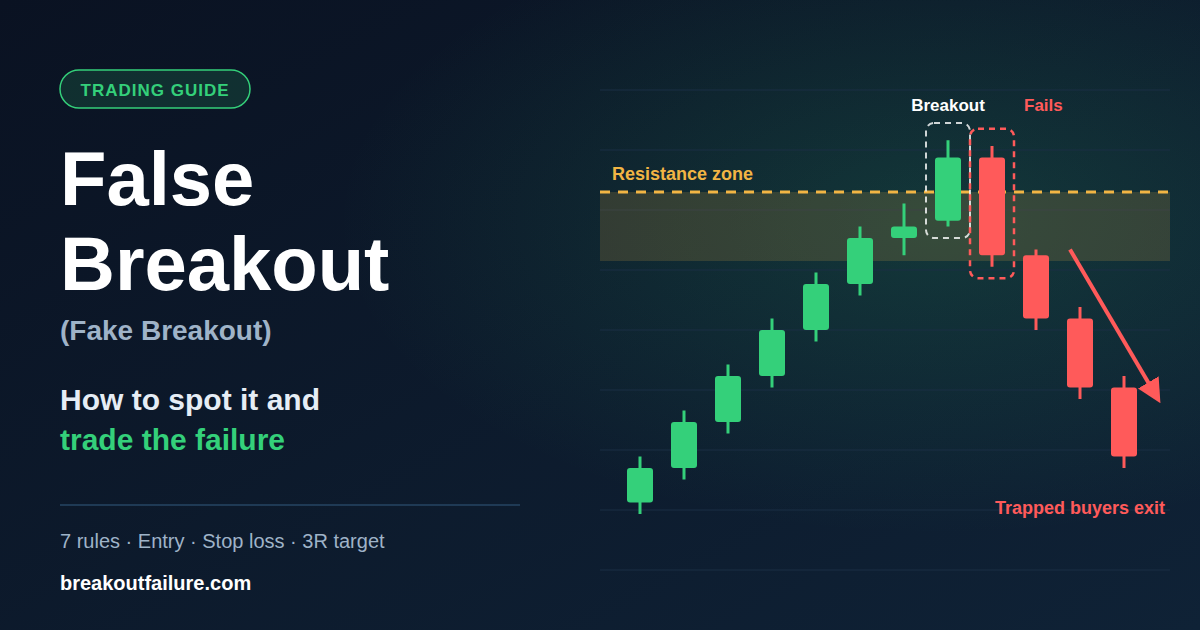
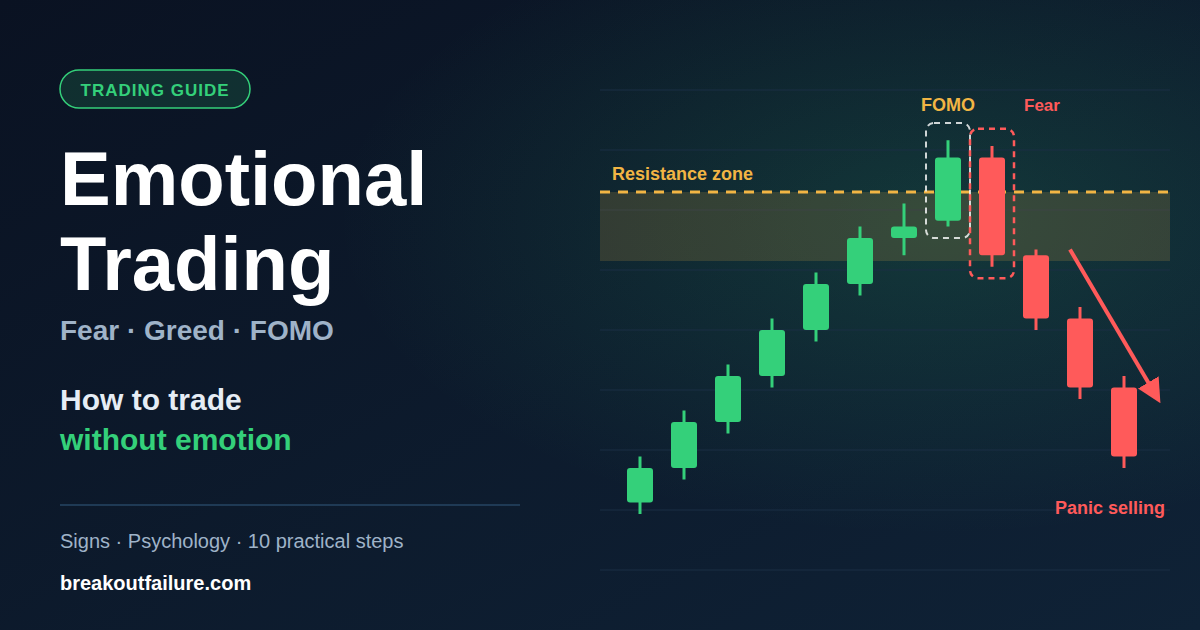
The clearest place to see emotional trading is a false breakout. Price breaks above a level everyone is watching, and emotional traders react in a predictable order:
- FOMO: they buy the breakout late, afraid to miss the move.
- Fear: the next candle closes back below the level.
- Hope: they hold, telling themselves it will come back.
- Panic: they sell near the low as their stop loss is hit.
Their panic selling is what makes the reversal fast. A disciplined trader sees the same chart differently: they wait for the failure candle to close, then trade the reversal with a fixed stop loss and target. Learn the full method in our guide to false breakouts and how to trade the failure.

Caption: What emotional traders feel at a false breakout, and what the disciplined trader does instead.
How to Trade Without Emotion: 10 Practical Steps
You cannot switch your emotions off. You can stop them from making decisions. The key is to make every important decision before the trade, when you are calm.
1. Write a Trading Plan
Write down which setups you trade, on which timeframes, during which hours, and how much you risk per trade. If it is not in the plan, you do not trade it.
2. Decide Entry, Stop Loss and Target Before You Enter
Use simple "if–then" rules: if the setup appears, then I enter here, my stop loss goes here and my target is here. Once the trade is live, there is nothing left to decide.
3. Risk a Fixed 1% or Less Per Trade
Size every position from your stop-loss distance:
Position size = Money you will risk ÷ Stop-loss distance
For example, with ₹5,00,000 capital and 1% risk, you risk ₹5,000. If your stop loss is ₹16 away, you buy about 312 shares. A single loss can never hurt enough to trigger panic.
4. Use a Fixed Target
A fixed target, such as three times your risk (3R), removes the most emotional decision of all: when to take profit. You do not have to guess whether to hold or exit.
5. Set a Daily Loss Limit
Decide in advance when you stop for the day, for example after losing 2% of capital or after two losing trades in a row. Losses after that point are usually emotional.
6. Use Alerts Instead of Staring at Charts
Staring at price all day creates stress and invites impulsive trades. Let alerts or a scanner tell you when a real setup appears, and check the chart only then.
7. Follow a Pre-Market Routine
Before the market opens, mark your key levels, check the news calendar and read your rules. Ten calm minutes before the open prevent many impulsive minutes after it.
8. Keep a Trading Journal
For every trade, record the setup, the entry, stop and target, whether you followed your rules, and how you felt before, during and after the trade. Patterns appear within a few weeks.
9. Take a Break After Losses
After a loss, step away from the screen for 15–30 minutes before the next trade. It breaks the link between the loss and a revenge trade.
10. Judge the Process, Not the Result
A trade that followed your rules and hit the stop loss is a good trade. A trade that broke your rules and made money is a bad one: it teaches you the wrong lesson.

Caption: How to trade without emotion: 10 steps to build trading discipline.
Why Rule-Based Trading Beats Emotional Trading
A rule-based system turns "Should I?" into "Does it meet the rules?". There is no room for hope, fear or FOMO in a yes-or-no question.
For example, the breakout failure (BOF) method uses only fixed rules:
- A candle must close beyond a Visible Reversal Zone.
- The next candle must close back inside the zone and beyond the breakout candle's range.
- The stop loss goes beyond the extreme of the trap and is never widened.
- The target is always three times the risk.
Expect Losing Streaks, So They Do Not Shock You
Even a good system loses often. At a 45% win rate, a 3R target still averages about +0.8R per trade:
Expectancy = (0.45 × 3) − (0.55 × 1) = +0.80R per trade
But the same win rate means long losing streaks are normal. Over 100 trades, there is roughly a 92% chance of at least one run of 5 losses in a row, and about a 73% chance of a run of 6. Knowing this in advance stops a normal losing streak from turning into panic, revenge trading or abandoning a working system.
Trading Psychology Exercises to Build Discipline
- Rule rehearsal: before the open, read your rules out loud and picture yourself following them in a losing trade.
- If–then planning: write down how you will respond to common situations, for example "If I lose two trades, then I stop for the day."
- Slow breathing: before clicking buy or sell, take three slow breaths. It creates a pause between impulse and action.
- Paper-trade your rules: follow your system for 20 trades on paper or with tiny size, and focus only on following the rules.
- Weekly journal review: once a week, count how many trades followed your rules. Aim to raise that number, not your profit.
Intraday Trading Discipline: Extra Rules for Day Traders
Intraday trading packs many decisions into a few hours, so emotions build up faster. These extra rules help:
- Set a maximum number of trades per day, and stop when you reach it.
- Stop for the day after two losing trades in a row.
- Avoid trading the first spike after big news, results or RBI announcements.
- Set a fixed session end time. Late-day trades are often tired, emotional trades.
- Close all intraday positions by your plan's cut-off, never "hoping" into the close.
Let BOF Scanner Do the Watching
One of the easiest ways to trade without emotion is to stop staring at charts. BOF Scanner scans stocks, indices and commodities every 5 minutes for breakout failures around Visible Reversal Zones, and sends you a push notification when a rule-based setup appears.
- No chart-staring: you look at the market only when a setup meets the rules.
- No FOMO: alerts come from fixed rules, not from how fast price is moving.
- Your style: intraday, swing and positional alerts, plus a sector heatmap and favourites lists.
Trade the rules, not your feelings. Download BOF Scanner and let the setups come to you.
Emotional Trading FAQs
What is emotional trading?
Emotional trading is making trading decisions based on fear, greed, hope, FOMO or regret instead of a written plan. Common examples are chasing moves, moving stop losses and revenge trading.
How do I trade without emotion?
Decide your entry, stop loss, target and position size before the trade, risk a fixed small amount per trade, use a fixed target, set a daily loss limit and keep a trading journal.
Can you remove emotions from trading completely?
No. Every trader feels emotions. The goal is to stop emotions from changing decisions, by making those decisions in advance with written rules.
What are the most common emotions in trading?
Fear, greed, FOMO, hope, regret and overconfidence. Fear and greed are the two that most often lead to early exits, oversized trades and chasing moves.
What is an emotional trader?
An emotional trader is someone whose entries, exits and position sizes change with their feelings or recent results, instead of following fixed rules.
Why do I lose money when I break my trading rules?
Rules exist to protect you in the moments when emotions are strongest. Breaking them usually means a bigger loss, a worse entry or an exit at the wrong time.
Does a trading journal really help?
Yes. Writing down your rule-following and your emotions for each trade shows patterns you cannot see in the moment, such as always overtrading after a loss.
How does automation help emotional traders?
Alerts and scanners remove the need to watch every tick. You only look at the market when a rule-based setup appears, which cuts impulsive trades.
Key Takeaways
- Emotional trading is letting fear, greed, hope or regret change a decision you already made.
- You cannot remove emotions, but you can make every key decision before the trade.
- Fix your risk per trade, your stop loss and your target in advance.
- Expect losing streaks: at a 45% win rate, 5 losses in a row is normal over 100 trades.
- Judge yourself by rule-following, not by the result of a single trade.
Conclusion
Emotional trading is the most common way traders turn a good strategy into losses. The fix is not to feel less, but to decide more in advance. Write your plan, fix your risk, use a fixed target, set a daily loss limit, and review your journal every week. Rules made when you are calm will protect you when the market is not. When you are ready, let BOF Scanner bring rule-based setups to you, so you can stop watching every tick.
About the author: ST Aka Suresh Duraisamy (B.E., Computer Science Engineering) is the author of the research paper Breakout Failure in Financial Markets: A Behavioural and Structural Analysis Using Visible Reversal Zones.
Disclaimer: This article is for educational purposes only and is not investment advice or a recommendation to buy or sell any security. Trading in equities and derivatives involves a high risk of loss. All examples are illustrative. Consult a SEBI-registered investment adviser before making trading decisions.