
Select a trading day to view all Scanner results, chart evidence, and market explanations.
3 Scanners Available
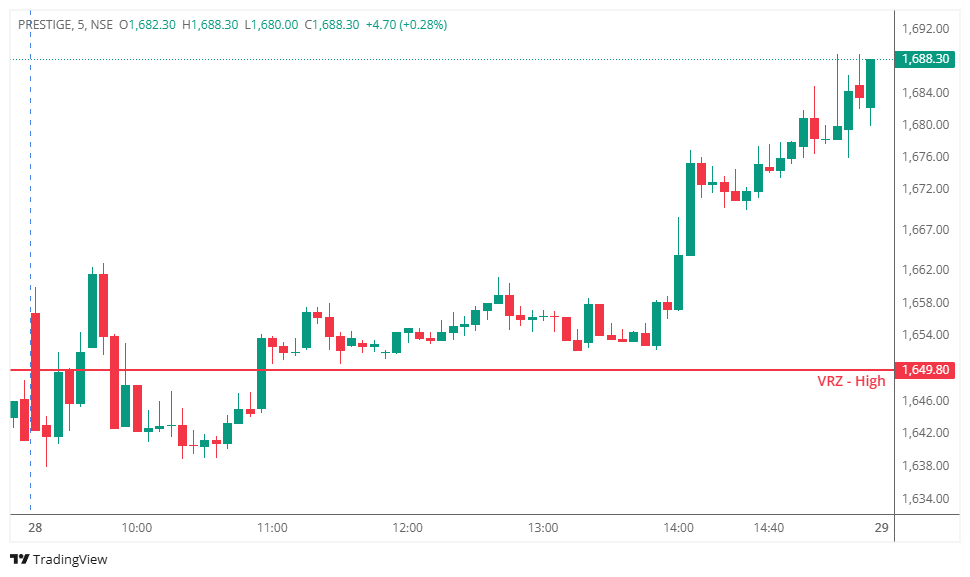

PRESTIGE traded around the VRZ High for a considerable period, indicating a key decision area between buyers and sellers. As price tested the resistance zone multiple times, traders anticipated a potential Breakout Failure (BOF) that could trigger a short-selling opportunity.
The initial rejection near the VRZ High appeared promising and satisfied the entry conditions of the BOF strategy.
Price briefly moved above the VRZ High level of ₹1,649.80, attracting breakout buyers before showing signs of rejection. As the price slipped back below the breakout zone, the BOF short setup was triggered.
However, the expected bearish continuation never materialized.
Instead, buyers aggressively absorbed every selling attempt and successfully defended the breakout area. Price quickly reclaimed the VRZ High, invalidating the bearish structure and triggering the predefined stop loss.
After removing weak short positions from the market, bullish momentum accelerated dramatically. The stock produced a powerful breakout and continued making higher highs and higher lows, resulting in a strong trend continuation throughout the session.
The failed BOF ultimately became a confirmation of buyer strength rather than a reversal signal.
The bearish setup lost its probability because the market refused to accept lower prices.
Several warning signs confirmed the failure:
❌ Price quickly reclaimed the VRZ High after entry.
❌ Sellers failed to create follow-through momentum.
❌ Strong bullish candles appeared immediately after the reclaim.
❌ Buyers defended every minor pullback aggressively.
❌ Market structure shifted from consolidation to bullish trend continuation.
Once buyers established control above the VRZ zone, the BOF thesis became invalid.
The chart clearly highlights a classic failed BOF followed by breakout continuation.
📌 Breakout buyers initially entered above resistance.
📌 Short sellers anticipated a failed breakout.
📌 Selling pressure disappeared almost immediately.
📌 Buyers reclaimed the VRZ level with conviction.
📌 A momentum breakout followed, producing a sustained rally.
This type of move often traps early short sellers while rewarding traders who recognize the strength of a genuine breakout.
⚠️ Every BOF setup carries a probability of failure—no trading strategy delivers a 100% win rate.
📉 A failed trade does not indicate poor execution; it simply reflects changing market conditions and shifting market sentiment.
🏦 Professional traders understand that markets are dynamic. Even high-probability BOF setups can fail when strong institutional buying absorbs selling pressure and drives prices higher.
🛡️ Accepting these outcomes while strictly following predefined entry, exit, and risk management rules is what separates disciplined traders from emotional traders.
🎯 Success in trading comes from consistency, discipline, and process—not from winning every single trade.
A BOF Short setup becomes vulnerable when:
❌ Price quickly reclaims the breakout zone.
❌ Buyers continue forming higher lows after entry.
❌ Selling momentum fails to expand.
❌ Bullish candles dominate immediately after rejection.
❌ Volume supports the breakout instead of the reversal.
✅ Every setup has a statistical failure rate.
✅ A controlled stop loss protects long-term trading capital.
✅ Failed BOF setups frequently lead to powerful breakout continuations.
✅ Never hold a losing position hoping the market will reverse.
✅ Consistency comes from disciplined execution—not perfect predictions.
✅ Trading success is measured over hundreds of trades, not a single outcome.
This trade fully complied with the Logical Trading System (LTS) rules, making it a high-quality execution despite the loss.
Professional traders focus on process rather than individual outcomes.
A disciplined trader:
✔️ Executes only valid setups.
✔️ Accepts losses without hesitation.
✔️ Protects capital through predefined risk.
✔️ Remains emotionally neutral after every trade.
Losses are not failures—they are simply part of a probability-based trading business.
Successful traders prioritize capital preservation over being right.
In this trade:
✅ Strategy rules were followed.
✅ Entry was valid.
✅ Stop loss was respected.
✅ Risk remained controlled.
✅ No emotional averaging or revenge trading occurred.
Protecting capital ensures traders remain prepared for the next high-probability opportunity.
🌍 Markets are designed to test patience, discipline, and risk management—not emotions.
⚠️ This PRESTIGE BOF Failure demonstrates that a failed reversal can often become the strongest trend continuation signal.
🛡️ The objective of professional trading is not to avoid losses, but to keep them small, controlled, and consistent through disciplined risk management.
📈 Long-term success comes from allowing winning trades to significantly outperform losing trades while following a rule-based trading process.
💪 Stay disciplined, trust the process, and let consistency—not emotions—drive your trading journey.
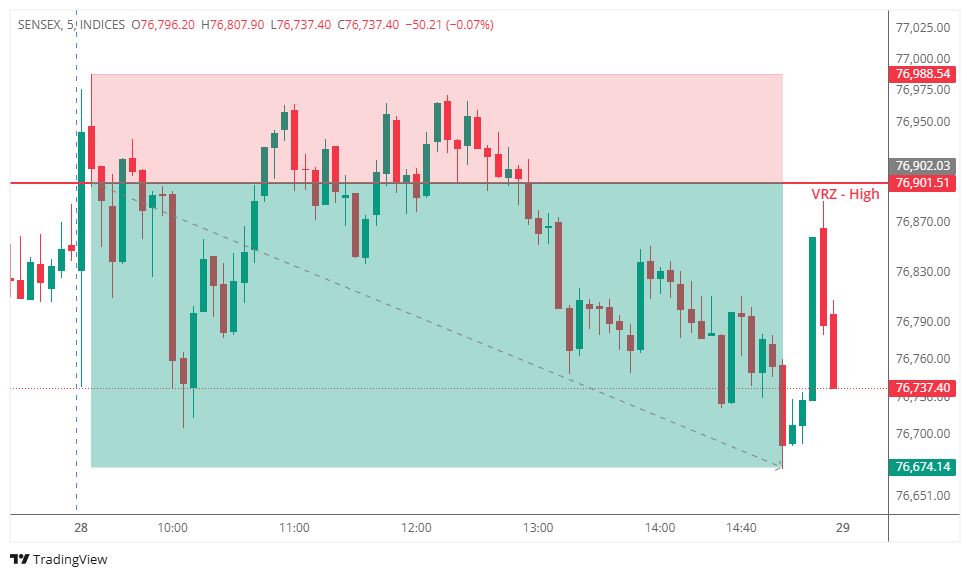

🔹 SENSEX repeatedly tested the VRZ High but failed to sustain above the resistance zone.
⚠️ The failed breakout and rejection back below the VRZ High confirmed the BOF setup, giving sellers an opportunity to take control.
📉 As price moved back below the key zone, bearish momentum strengthened and sellers gained control.
🎭 The failed breakout trapped bullish participants, while the rejection signaled weakening buyer momentum and supported the bearish reversal.
🔸 Wait for Confirmation – Allowing price to reject the VRZ High helped validate the BOF setup.
🔹 Follow Price Action – Waiting for the market to confirm the reversal reduced the risk of anticipating the move.
🟢 Manage Risk – The VRZ High provided a clear reference for trade invalidation and risk management.

📊 SENSEX delivered a confirmed Breakout Failure at the VRZ High, followed by a bearish intraday move.
🎯 The setup achieved a 0.30% bearish move with a 1:2 Risk-Reward.
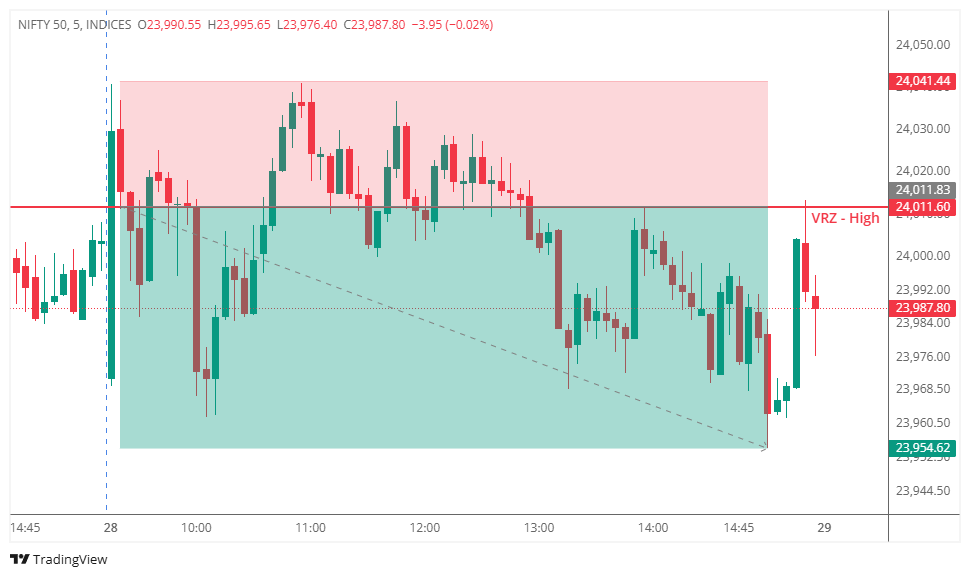

🔹 NIFTY 50 approached the VRZ High, creating a key resistance area for the session.
🟡 Buyers attempted to push the index above this level, expecting a continuation of the bullish move.
⚠️ However, price failed to sustain above the VRZ High, indicating weakness in the breakout attempt.
📉 The rejection created a potential Breakout Failure (BOF) setup and shifted attention toward the downside.
🔻 After the failed breakout, price moved back below the VRZ High, confirming the rejection.
📉 The inability to hold above resistance weakened bullish momentum and gave sellers an opportunity to take control.
💥 As trapped breakout buyers began exiting, selling pressure increased and pushed price lower.
🎯 The confirmed BOF setup delivered a 0.24% bearish move with a 1:2 Risk-Reward.
🟢 Buyers: Attempted to sustain the breakout above the VRZ High.
🟡 Breakout Participants: Entered expecting bullish continuation but became trapped when price rejected the zone.
🔴 Sellers: Took control after the failed breakout and pushed price back below resistance.
📉 Final Outcome: Seller dominance resulted in a confirmed intraday bearish reversal.
🎭 The initial breakout created optimism among buyers, but the failure to sustain above resistance quickly changed market sentiment.
🚨 Trapped buyers were forced to reconsider their positions as price returned below the VRZ High.
📉 This shift in sentiment created additional selling pressure and strengthened the bearish move.
🎯 The setup highlights how a failed breakout can become a powerful reversal signal when supported by confirmation.
1️⃣ Failed Breakouts Can Signal Strong Reversals
A breakout that fails to sustain above resistance can quickly shift momentum toward sellers.
2️⃣ Confirmation Improves Trade Quality
Waiting for price to reject the VRZ High and move back below the zone helped confirm the BOF setup.
3️⃣ Defined Risk Supports Better Execution
Using the VRZ High as the invalidation level provided a clear reference for disciplined risk management.
4️⃣ Avoid Predicting the Reversal
Instead of assuming the breakout would fail, waiting for confirmation allowed traders to react to actual market behavior.
5️⃣ Market Structure Matters
The rejection at a key VRZ level combined with bearish follow-through created a higher-quality intraday setup.
📌 The key opportunity came after the breakout failed to sustain above the VRZ High.
⏳ Patience was important as the setup required confirmation before the bearish move became valid.
📉 Once price accepted back below the resistance zone, the trade aligned with the emerging bearish momentum.
⚖️ A clearly defined invalidation level helped maintain a structured 1:2 Risk-Reward approach.
📊 NIFTY 50 showcased a clear Breakout Failure at the VRZ High, followed by bearish price action.
🔻 The failed breakout shifted short-term control from buyers to sellers.
🎯 The setup ultimately delivered a 0.24% downside move while maintaining a 1:2 Risk-Reward.
📚 This trade demonstrates the importance of confirmation, market psychology, disciplined execution, and risk management when trading BOF setups.