
Select a trading day to view all Scanner results, chart evidence, and market explanations.
2 Scanners Available
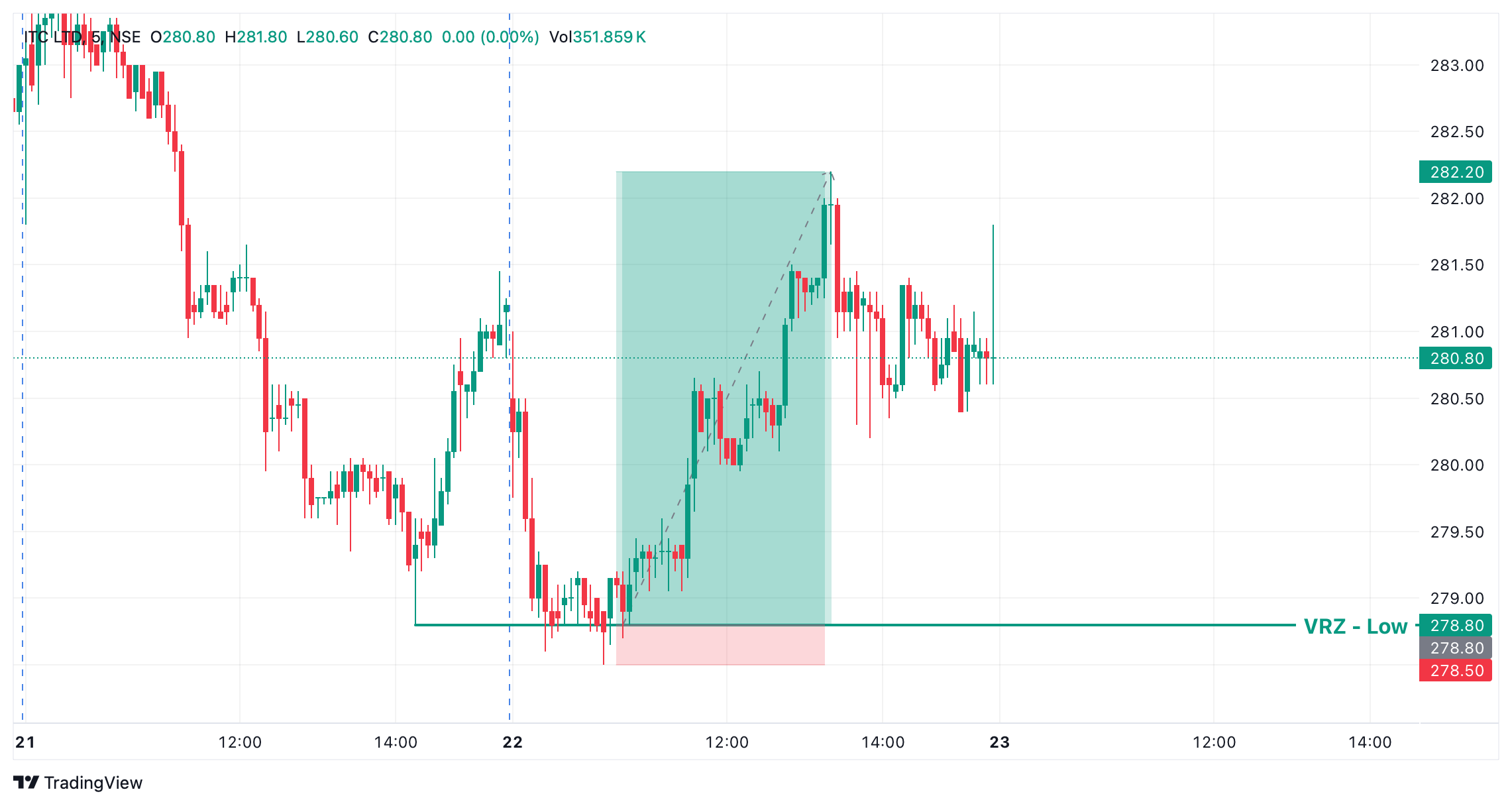
Stock: ITC Ltd (NSE)
Timeframe: 5 Minutes
BOF Signal Time: 10:35 AM
Pattern: Breakout Failure (BOF) at VRZ Low
Entry Price: 278.80
Trade Type: Intraday Long
Risk-to-Reward: 1:11 RR

Every trader dreams of catching a trade that offers minimal risk and exceptional reward. The challenge is that these opportunities are rare—and even harder to identify before the move unfolds.
On this trading session, ITC delivered exactly that.
A textbook Breakout Failure (BOF) formed at the VRZ Low, creating an ideal environment for buyers to step in after sellers failed to maintain control.
Rather than chasing price after it had already rallied, the BOF setup provided a disciplined entry with a clearly defined stop-loss. The result was an outstanding 1:11 Risk-to-Reward intraday trade.
The trading day began with heavy selling pressure.
ITC opened weak and continued making lower highs and lower lows. Sentiment was clearly bearish, and many traders expected the decline to continue throughout the session.
As price approached the VRZ Low (278.80), selling pressure intensified. The market appeared ready for another downside breakout.
For breakout traders, this looked like the perfect short-selling opportunity.
But the market had other plans.
The Volume Reference Zone (VRZ) represents an important price level where the market has previously shown significant participation.
When price reaches the VRZ Low, traders closely watch whether sellers can successfully push the stock lower.
There are only two possible outcomes:
On ITC, the second scenario unfolded perfectly.
At 10:35 AM, ITC briefly traded below the VRZ Low, giving the impression that the bearish trend was about to accelerate.
Many traders entered fresh short positions as the support appeared to break.
However, instead of continuing downward, buyers immediately absorbed the selling pressure.
Within a short period:
This reclaim of the VRZ Low marked the beginning of a high-probability long setup.
The breakdown attracted aggressive short sellers who believed support had failed.
When price moved back above the VRZ Low, those positions immediately came under pressure.
As they exited, their buying added fuel to the rally.
The swift recovery above the VRZ Low showed that institutional buying interest was present.
Instead of allowing price to remain below support, buyers quickly regained control.
This shift in order flow changed the market structure from bearish to bullish.
One of the biggest advantages of BOF trading is the ability to define risk precisely.
Since the stop-loss was placed just below the failed breakdown, the downside risk remained very small.
As the rally developed, the reward expanded significantly, resulting in an impressive 1:11 Risk-to-Reward.
This is the type of trade where a single winner can offset multiple small losses, highlighting the importance of disciplined risk management.
The long position was initiated after price reclaimed the VRZ Low, confirming that the breakdown had failed.
Waiting for confirmation helped filter out false entries and ensured buyers had regained control.
The stop-loss was placed just below the lowest point of the failed breakdown.
If price had moved below this level again, the BOF setup would have been invalidated.
Rather than exiting early, traders who followed their trade plan allowed the position to run.
The strong bullish momentum eventually produced approximately 1:11 Risk-to-Reward, demonstrating the value of letting winning trades develop.
Breakdown failures create one of the strongest emotional shifts in financial markets.
Initially, bearish traders become confident after seeing price move below support.
This confidence often attracts additional short positions.
When the breakdown fails, that confidence quickly turns into panic.
Short sellers begin covering their positions while new buyers enter the market.
This combination creates powerful upward momentum.
In ITC, the market transformed from apparent weakness into sustained strength within a short period, rewarding patient traders who waited for confirmation rather than reacting to the initial breakdown.
Although this trade delivered an exceptional return, it is important to remember that not every BOF setup will produce a 1:11 move.
Professional traders focus on:
Consistency comes from following the process, not from expecting every trade to become a home run.
The strongest trades often emerge when the market proves the crowd wrong.
ITC's move demonstrates that a breakdown below support is not automatically bearish. What matters is whether price can sustain below that level. When sellers failed to hold beneath the VRZ Low, the market revealed hidden buying strength, creating one of the highest-quality intraday opportunities of the session.
Rather than reacting to the initial breakdown, waiting for the Breakout Failure (BOF) confirmation allowed traders to enter with limited risk and participate in a substantial rally. Trades like this reinforce a key principle of BOF trading: it's not the breakout that creates the opportunity—it's the failure of the breakout.
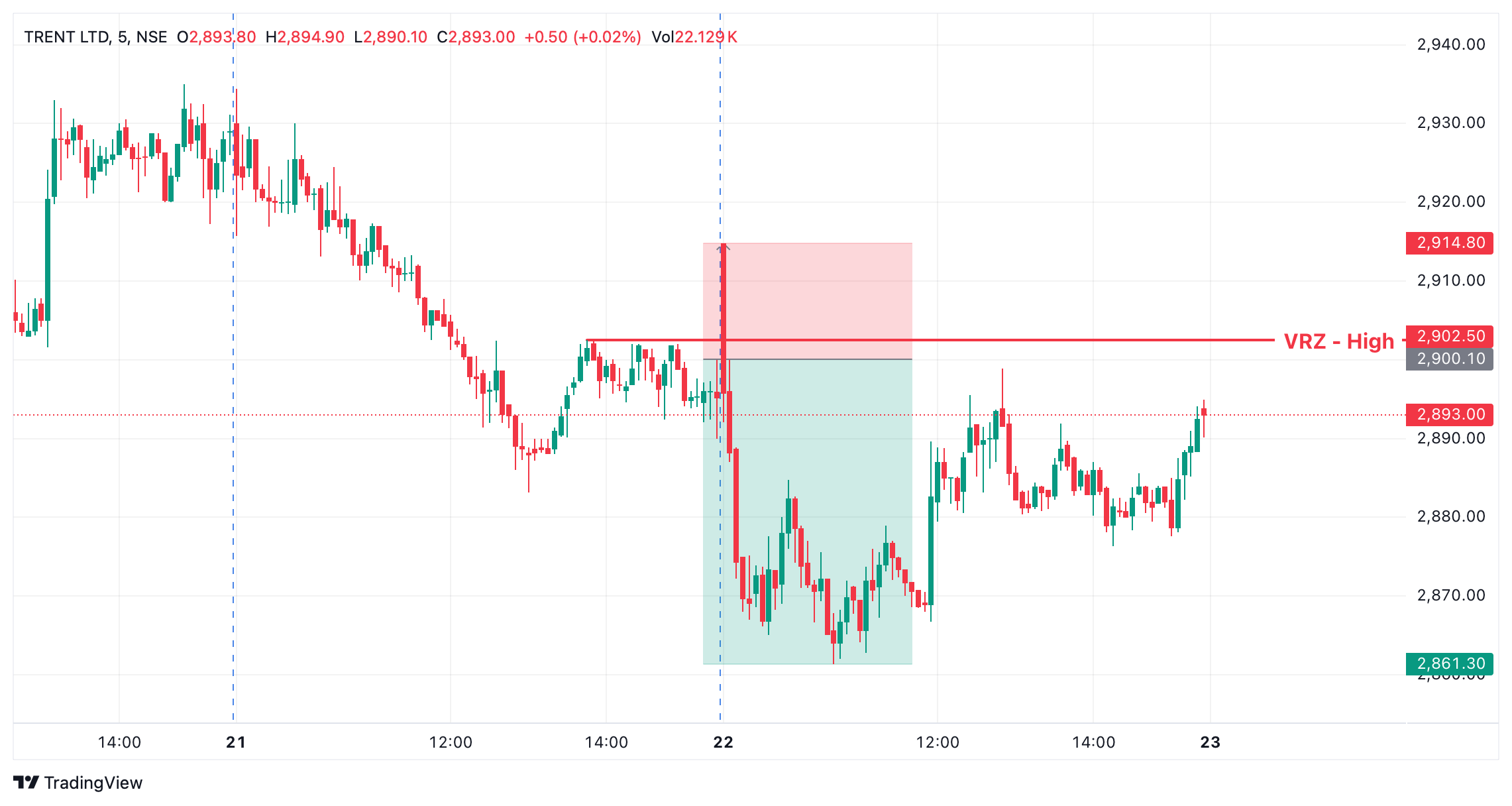
Stock: TRENT Ltd (NSE)
Timeframe: 5 Minutes
Trade Type: Intraday Short
Pattern: Breakout Failure (BOF) at VRZ High
Risk-to-Reward: 1:2.6 RR

Not every breakout deserves to be traded.
One of the biggest mistakes traders make is assuming that every move above resistance will continue higher. In reality, many breakouts fail because there isn't enough buying pressure to sustain the move.
Today's TRENT chart is a textbook example of why waiting for Breakout Failure (BOF) confirmation can produce high-probability trades with controlled risk.
Instead of buying the breakout, BOF traders waited for the market to reveal weakness and the result was a clean 1:2.6 Risk-to-Reward opportunity.
Before the BOF signal appeared, TRENT had already been showing signs of weakness.
Many traders expected this breakout to reverse the bearish trend.
Instead, the market had a different plan.
As the market opened, TRENT produced a strong bullish candle that surged above the VRZ High (2902.50).
To breakout traders, everything looked perfect:
Many traders entered long positions expecting a continuation toward higher levels.
However, the breakout lacked one critical ingredient:
Follow-through buying.
Within minutes, buyers lost control.
A large bearish candle completely erased the breakout and pushed price back below the VRZ High.
At this point, the breakout was officially invalidated.
This is the exact moment where the Breakout Failure (BOF) setup became active.
A failed breakout creates one of the strongest psychological shifts in the market.
Traders who entered on the breakout suddenly found themselves holding losing positions.
Instead of adding buyers, the breakout created future sellers.
Large participants often use breakout enthusiasm to distribute positions.
Rather than chasing higher prices, they sold into the buying pressure.
Once buying dried up, price reversed aggressively.
As price moved back below the breakout level:
All three factors increased selling pressure simultaneously.
This created a fast downside move.
Enter the short position only after price closes back below the VRZ High, confirming that buyers have failed to defend the breakout.
Place the stop loss just above the breakout candle's high.
If price moves above that level again, the BOF setup becomes invalid.
The downside target was previous intraday support.
TRENT comfortably achieved approximately 1:2.6 Risk-to-Reward, providing an excellent balance between risk and profit.
Most traders are trained to buy strength.
Professional traders wait to see whether that strength survives.
There is a huge difference.
A breakout only tells us that buyers attempted to take control.
A Breakout Failure tells us that buyers failed.
Failure often produces stronger moves than the breakout itself because trapped traders become forced sellers.
That is exactly what happened in TRENT.
Even the highest-quality BOF setups can fail.
Always remember:
The objective is not to predict every breakout.
The objective is to identify when the market proves the breakout was wrong.
The best trades often come after the market disappoints the majority.
A breakout attracts attention.
A breakout failure creates opportunity.
TRENT demonstrated how patience and confirmation can outperform emotional breakout chasing. Instead of reacting to the first move above resistance, waiting for the failure allowed traders to participate in a cleaner, lower-risk setup with a defined stop-loss and a favorable 1:2.6 RR outcome.
If you consistently focus on identifying Breakout Failures around key VRZ levels, you'll avoid many false breakouts and improve the quality of your trade selection over time.