
Select a trading day to view all Scanner results, chart evidence, and market explanations.
3 Scanners Available
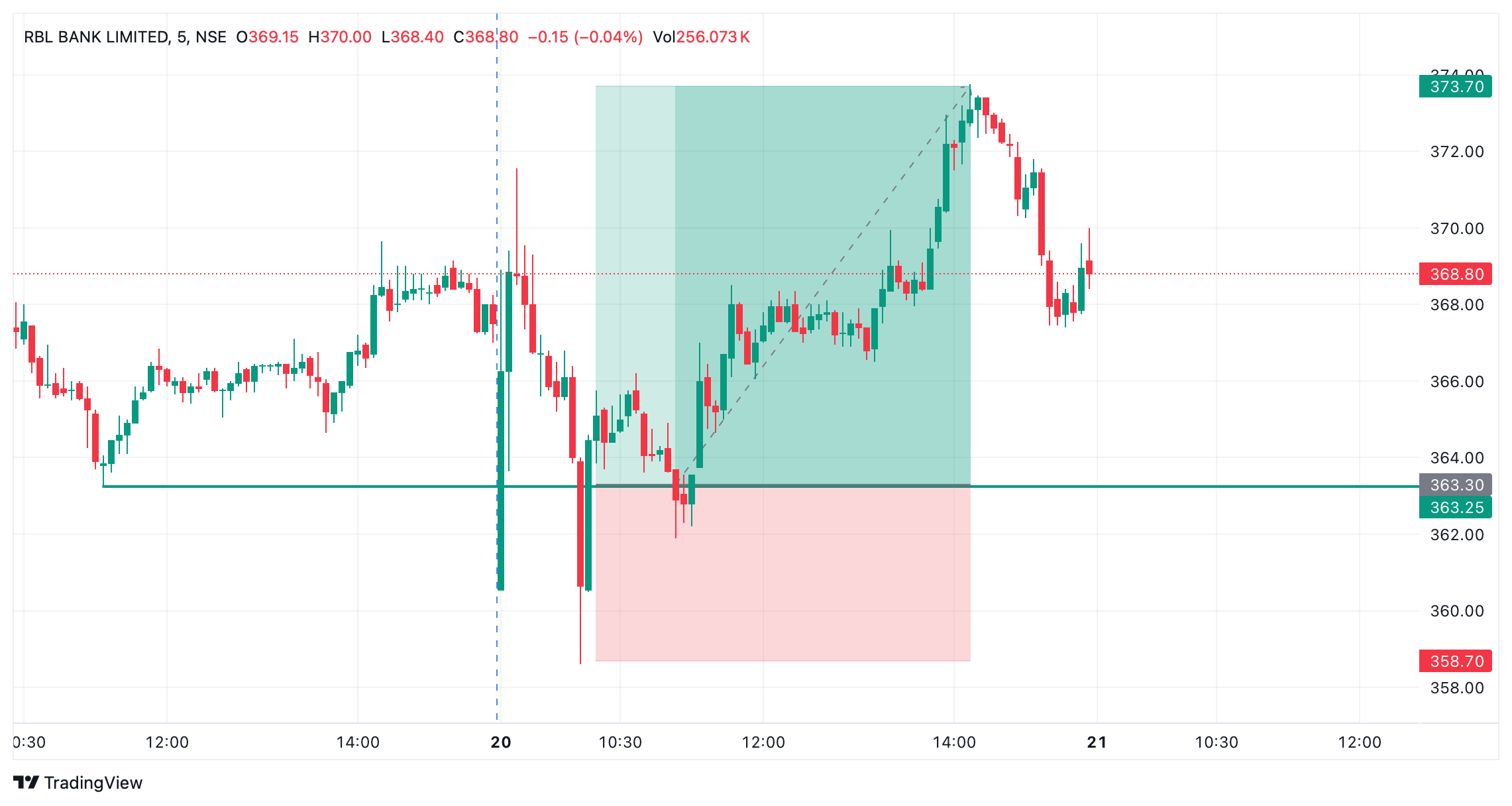
BOF Scanner App identified this setup at 10:15 am

Not every profitable trade needs to generate a massive return. Consistently capturing quality setups with controlled risk is what builds long-term trading success.
This RBL Bank trade is a perfect example. A BOF signal formed near the VRZ Low, offering an early entry with limited downside. The trade later achieved approximately 1:2.5 Risk-Reward, rewarding traders who trusted the setup instead of reacting emotionally.
The trading session began with aggressive selling pressure, pushing the price below the important VRZ Low.
At first glance, it appeared that sellers had complete control.
However, the breakdown failed to attract follow-through selling.
Instead, buyers stepped in aggressively and pushed the price back above the VRZ level. This quick recovery confirmed that the downside breakout had failed—a classic Breakout Failure (BOF).
Rather than signalling weakness, the failed breakdown became a buying opportunity.
Once the BOF was confirmed:
Although the move wasn't explosive, it provided a clean, disciplined trade with an attractive reward relative to the risk taken.
Several factors increased the probability of success:
These are the characteristics traders should look for when evaluating BOF opportunities.
False breakdowns often create emotional decisions.
Many traders sell as soon as support appears to break. When the market quickly recovers above that level, those sellers become trapped.
As they begin covering their positions, additional buying pressure enters the market.
This combination of:
often fuels a sustained upward move, exactly as seen in RBL Bank.
A successful trading strategy isn't about waiting only for huge winners.
Trades delivering 1:2 or 1:3 Risk-Reward with disciplined risk management can significantly improve long-term consistency.
The important lesson is to focus on:
When these elements align, even moderate reward trades contribute meaningfully to overall profitability.
The RBL Bank trade reinforces an important principle of the BOF Scanner: markets often reward traders who understand failed breakouts, not those who chase successful ones.
By identifying the rejection at the VRZ Low, the setup provided a low-risk entry and a structured move that delivered approximately 1:2.5 Risk-Reward.
In trading, consistency comes from repeatedly executing high-probability setups—not from trying to predict every market move.
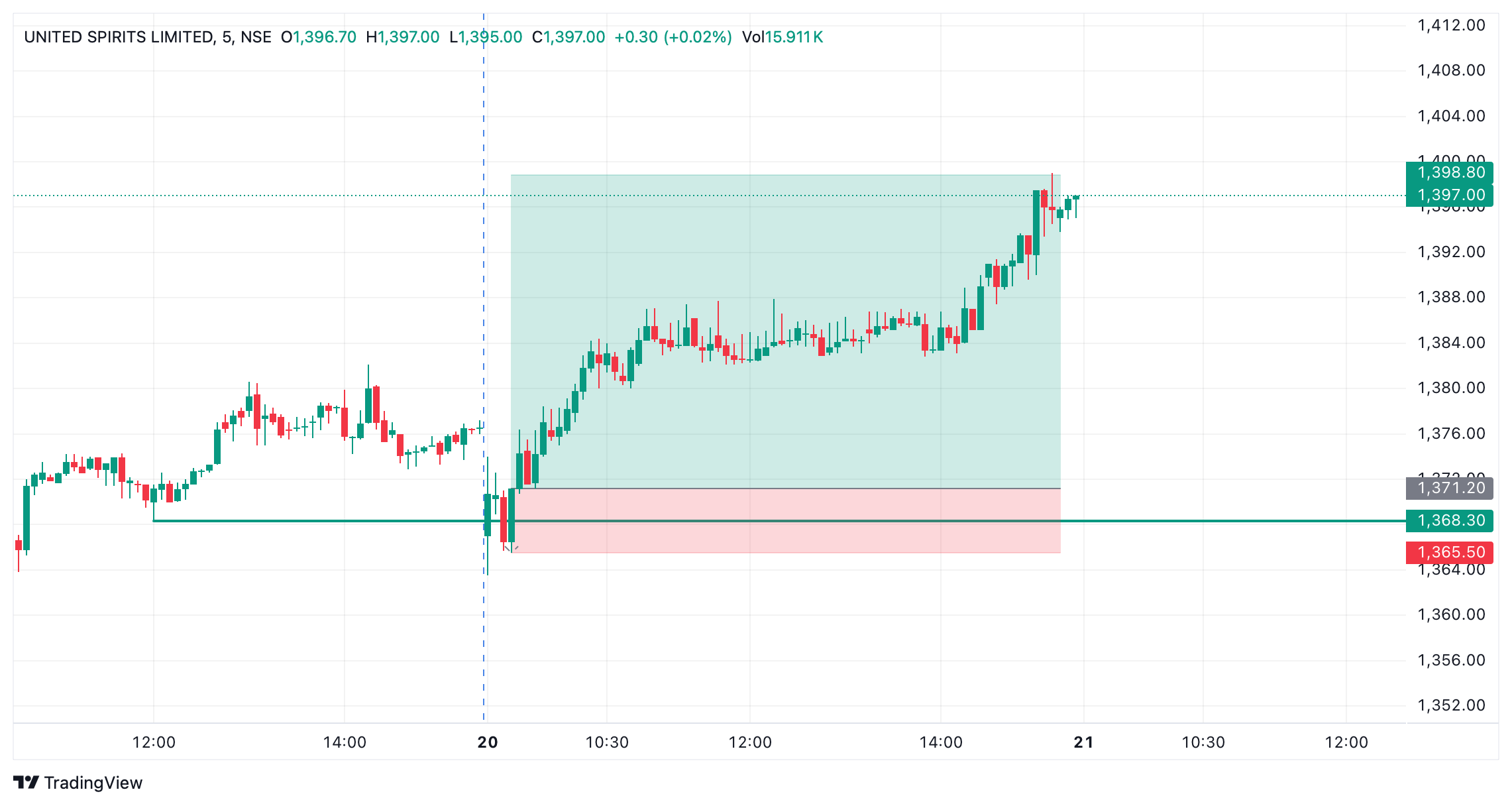
Excellent trade. This United Spirits (UNITDSPR) BOF at VRZ Low respected the level almost immediately and delivered a clean trend throughout the session.

Every trader dreams of finding trades that require small risk but offer the potential for large rewards. On United Spirits, the BOF Scanner identified exactly that kind of opportunity.
Instead of chasing price after a breakout, the BOF setup waited for the market to reject lower prices near an important demand zone. Once buyers defended the VRZ Low, the probability shifted in favour of the bulls.
The stock briefly moved below the VRZ Low, creating the impression that the support had failed.
Many traders panic during these moments and exit their positions or even initiate fresh shorts.
However, the BOF Scanner detected something different.
Price quickly reclaimed the VRZ level, signalling that the breakdown lacked conviction and that buyers had absorbed the selling pressure.
This is the essence of a Breakout Failure (BOF).
Once the BOF trigger appeared:
The trade eventually produced approximately 1:5 Risk-Reward, while the initial risk remained tightly controlled below the VRZ level.
This is exactly the type of asymmetrical opportunity professional traders seek.
Several factors aligned:
The combination of structure, psychology, and momentum created a high-quality setup.
False breakdowns often trap impatient sellers.
When those short positions realise price isn't continuing lower, they begin covering their trades.
At the same time, new buyers enter after the BOF confirmation.
This creates a powerful combination of:
The result is often a sustained directional move, exactly as seen in United Spirits.
The biggest profits rarely come from predicting breakouts.
They often come from recognising when the market rejects a breakout.
A failed breakdown near a strong VRZ level can provide:
This United Spirits trade is another example of how the BOF Scanner focuses on market behaviour rather than simply reacting to breakouts.
Instead of buying after a large move, the BOF setup identified the shift in control at the point where most traders were caught on the wrong side.
The outcome was a disciplined trade with roughly 1:5 Risk-Reward, proving once again that understanding failed breakouts can be far more valuable than chasing successful ones.
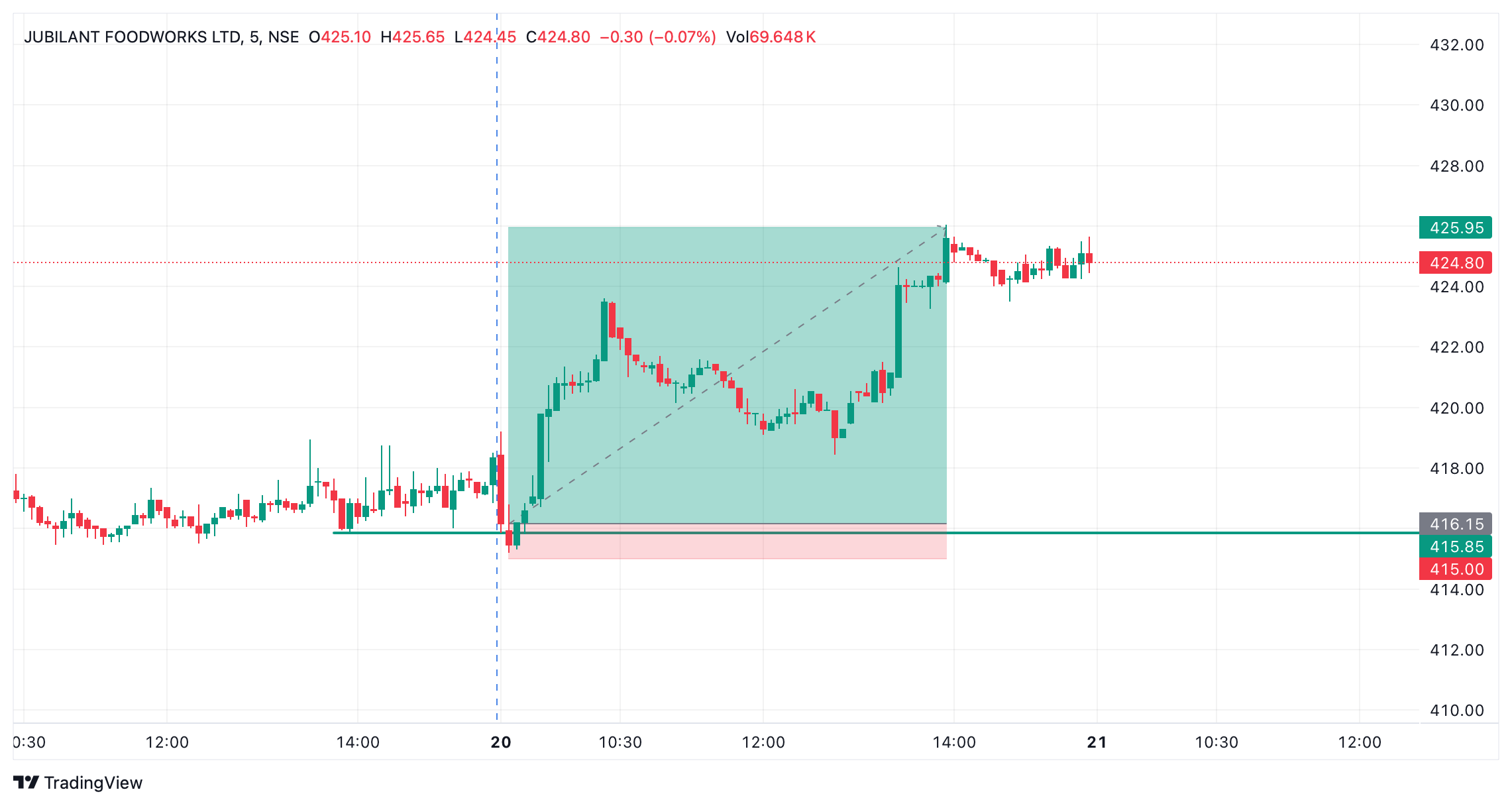
Stock: Jubilant FoodWorks Ltd. (JUBLFOOD)
Timeframe: 5 Minutes

High Risk-to-Reward (RR) trades are rare, but they often begin with a simple concept—a failed breakout.
On this trading session, Jubilant FoodWorks (JUBLFOOD) produced an excellent BOF (Breakout Failure) setup that resulted in an impressive 1:8 Risk-to-Reward opportunity.
The trade demonstrates how waiting for confirmation, rather than chasing price, can produce trades with limited downside and significant upside potential.
During the opening session, JUBLFOOD moved below an important VRZ Low level, suggesting that sellers were attempting to push the stock lower.
At first glance, it appeared to be a bearish breakdown.
However, the selling pressure quickly weakened.
Instead of continuing downward, buyers aggressively stepped in and reclaimed the VRZ Low.
This shift in momentum transformed the breakdown into a Breakout Failure (BOF).
The setup followed a structured process:
Because the invalidation level was very close to the entry, the trade offered minimal risk while allowing substantial upside.
Several factors contributed to the strong move:
The failed breakdown showed that sellers could not maintain control below the VRZ Low.
Since the entry occurred immediately after confirmation, the risk remained very small.
A smaller stop naturally increases the achievable Risk-to-Reward ratio when the trend develops.
Once buyers gained control, the stock continued making higher highs and higher lows instead of reversing immediately.
This allowed traders to stay in the trade longer.
Many traders exit after achieving a quick 1:2 or 1:3 reward.
Allowing the trade to continue according to the trading plan enabled this setup to reach nearly 1:8 RR.
This example highlights several important trading principles:
Many traders focus only on winning percentage.
Professional traders often focus more on Risk-to-Reward.
For example:
Overall result:
+3R
This illustrates why a few high-quality trades can outweigh several small losses.
BOF Scanner simplifies the search for these opportunities by:
Instead of reacting emotionally to price movements, traders can follow objective BOF signals and manage trades with discipline.
The JUBLFOOD 1:8 Risk-to-Reward trade is a strong example of why successful trading is not about predicting every market move—it is about identifying situations where the potential reward significantly outweighs the risk.
Breakout Failure setups naturally provide well-defined stop-loss levels, allowing traders to participate in larger moves without taking excessive risk.
Not every BOF signal will generate an 8R winner, but consistently following high-probability setups with disciplined risk management can lead to sustainable long-term performance.