
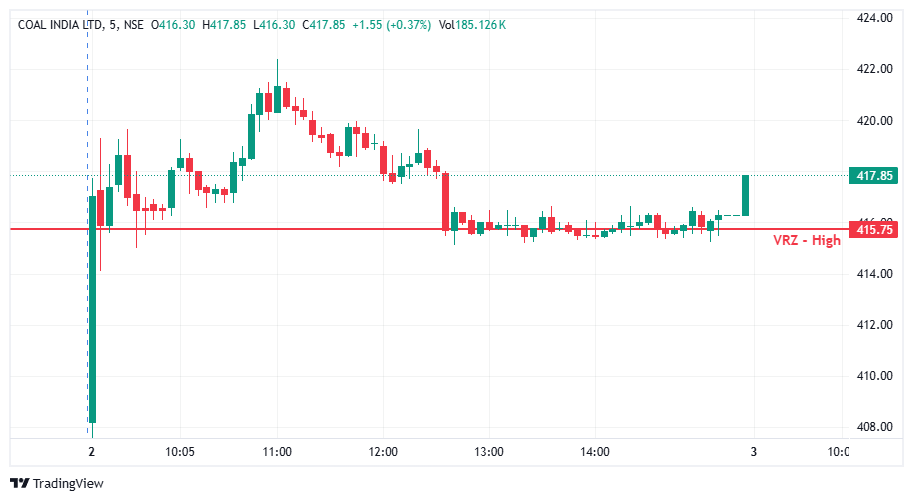

COALINDIA initially traded around the ₹415.75 VRZ High before experiencing significant volatility.
📈 Buyers pushed price above the reversal zone.
🔻 Sellers later attempted to drive price back toward the VRZ High.
🔄 Price then consolidated around the key level instead of developing a strong bearish continuation.
The lack of sustained selling pressure weakened the bearish BOF thesis.
The price structure showed that sellers were unable to build a decisive downtrend after the rejection.
📉 Initial selling pressure appeared near the higher levels.
⚠️ Downside momentum gradually weakened.
🔄 Price repeatedly stabilized around ₹415.75.
🟢 Buyers eventually returned with stronger momentum.
This structure reduced the probability of a successful bearish reversal.
The potential BOF short setup developed around the ₹415.75 VRZ High after price showed rejection from the breakout area.
Initially, the setup appeared to offer a possible bearish reversal.
However, price failed to sustain the move below the reversal zone. Instead, the stock consolidated near ₹415.75 and buyers gradually regained control.
The later bullish move above the zone invalidated the bearish BOF expectation and resulted in the predefined risk being triggered.
The primary reason for the BOF failure was insufficient bearish follow-through after the initial rejection.
❌ Sellers failed to extend the downside.
⚠️ Price remained close to the ₹415.75 VRZ High.
🔄 Repeated consolidation indicated indecision.
📈 Buyers gradually regained strength.
🚀 The final bullish expansion invalidated the bearish reversal idea.
These signals indicated that the rejection lacked the strength required for a sustained BOF short trade.
The chart highlights a failed bearish reversal followed by renewed buying interest.
📈 Buyers initially pushed COALINDIA above the VRZ High.
🔻 Sellers attempted to reverse the breakout.
⚠️ The bearish move lacked strong continuation.
🔄 Price stabilized around the reversal zone.
🟢 Buyers eventually produced a strong bullish candle, pushing price toward ₹417.85.
This demonstrates how a weak rejection can turn into a continuation move when buyers regain control.
⚠️ An initial rejection from VRZ High does not guarantee a successful BOF.
📊 Strong bearish follow-through is essential after a breakout failure.
🔍 Repeated consolidation around the reversal zone can signal weakening seller conviction.
🛡️ Predefined stop losses help control risk when the reversal thesis becomes invalid.
🎯 Waiting for confirmation is safer than assuming every rejection will become a bearish reversal.
The setup demonstrates an important psychological battle between buyers and sellers.
🔻 Sellers attempted to capitalize on the rejection above the VRZ High.
⚠️ When downside momentum failed to develop, short conviction weakened.
🟢 Buyers recognized the lack of bearish continuation and gradually returned.
🚀 The eventual bullish expansion trapped traders who remained committed to the failed reversal idea.
Professional execution requires accepting when the market invalidates the original trade thesis.
Effective risk management remains essential during BOF trading.
✔️ The trade idea was based on a predefined VRZ level.
✔️ Risk was identified before execution.
✔️ The stop loss provided protection when the bearish setup failed.
✔️ No emotional averaging was required.
✔️ Capital remained available for the next valid opportunity.
A controlled loss is preferable to allowing a failed setup to become an uncontrolled position.
🌍 Markets can quickly shift control between buyers and sellers.
⚠️ The COALINDIA BOF Failure demonstrates that rejection near a VRZ High alone is not enough to confirm a bearish reversal.
📉 Sellers need sustained follow-through below the reversal zone to validate the short setup.
📈 When price repeatedly holds near the VRZ and buyers eventually reclaim momentum, the bearish BOF thesis loses its strength.
🛡️ Disciplined traders focus on confirmation, risk control, and protecting capital rather than forcing a prediction.
💪 Follow the setup, respect the stop loss, and let price action decide the outcome.